

What the Utah Wolf Incident Reveals About State Wildlife Management
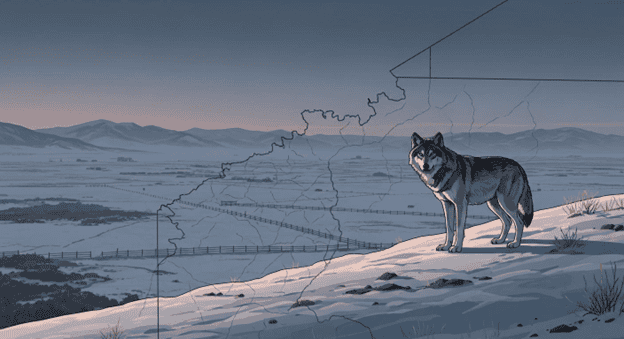
On January 9, 2026, a significant event in Northern Utah brought the complex intersection of federal law, state authority, and predator management into sharp focus for the hunting and conservation community. In a rural stretch of southwestern Cache County, the Utah Department of Agriculture and Food (UDAF) lethally removed three gray wolves after they were spotted in close proximity to livestock near the small agricultural community of Avon. While this action sparked debate among various interest groups, the removal was strictly grounded in specific state laws and geographical boundaries that define where the state holds the authority to manage predator populations. For hunters and proponents of state-led wildlife stewardship, this incident serves as a critical case study of how localized management plans function when federal protections are lifted in specific zones.
The Legal Distinction of the Removal Zone
The legality of this operation hinged entirely on geography and the specific recovery status of the gray wolf in different parts of the state. The three wolves were located in a region of northern Utah that lies mostly east of Interstate 15, extending roughly as far south as Ogden. This specific area is legally considered part of the greater Yellowstone region recovery zone.
Crucially, this is the only part of Utah where the state is currently permitted to manage wolves; in the rest of the state, the animal remains classified as an endangered species. Outside of this
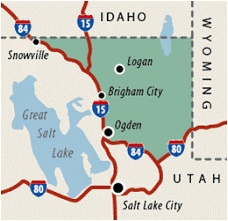
specific delisted zone, it remains illegal to hunt, harass, trap, shoot, or harm wolves without explicit permission from the federal government. This incident highlights the precision required in modern wildlife management, where state authority is often bounded by jurisdictional lines that determine when federal protections apply and when state authority is permitted.
Enforcing State Management Directives
Within this delisted zone, the Utah Division of Wildlife Resources (DWR) operates under a clear legislative mandate. State law directs the agency to prevent wolves from establishing breeding populations in this specific area. While the three wolves removed in January were not identified as a formal pack, officials believed they were traveling together. The state’s objective is preventative; the goal is to stop the establishment of breeding pairs before a population becomes entrenched and conflicts escalate.
“Lethal removals ensure they don’t establish breeding populations in Utah.”
— Faith Jolley, Utah Division of Wildlife Resources
The wolves were found near Avon, a census-designated community of about 500 residents surrounded primarily by farmland. Although critics noted there were no reports that these specific animals had killed livestock at the time of removal, the presence of predators near agricultural operations triggers the state's management protocols. This approach reflects a management philosophy that prioritizes the protection of rural livelihoods and ungulate populations over the expansion of predators into new territories.
The Broader Fight for State Authority
This incident occurred against a backdrop of significant legislative victories for state-based management advocates. Just weeks prior, in December 2025, Hunter Nation celebrated the passage of the Pet and Livestock Protection Act of 2025 (H.R. 845) by Congress. This legislation was designed to direct the U.S. Department of the Interior to remove the gray wolf from the Endangered Species Act (ESA) and reissue the November 2020 delisting rule.
“As packs begin to disperse seeking new territory, states are confronted with balancing wildlife populations with the rights and interests of landowners.”
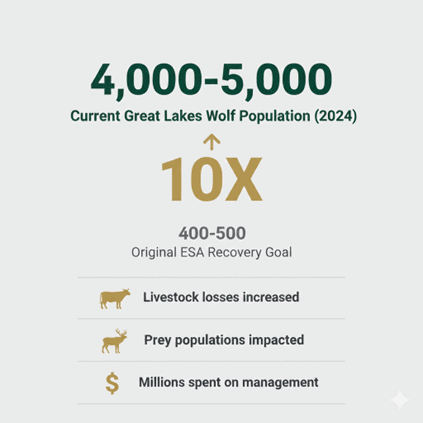
For hunters, ranchers, and rural communities, this legislative movement represents a necessary correction to years of federal overreach. Proponents argue that state agencies are better equipped to balance wildlife populations with the needs of rural communities. By 2024, wolf populations in the Great Lakes region had climbed to between 4,000 and 5,000—ten times the recovery goals—resulting in unprecedented livestock losses for ranchers and measurable impacts on elk, deer, and moose populations. The recent action in Utah reflects this philosophy: prioritizing local agricultural interests and ungulate herd health prevents the imbalances seen in other regions.
A History of Preparedness and Prevention
The history of wolf management in Utah illustrates that the state has long prepared for these scenarios. As far back as 2003, the Utah State Legislature passed HJR 12, urging the DWR to create a wildlife resource plan with specific goals for potential wolf establishment. A Wolf Working Group was subsequently established to draft management plans that balanced differing interests.
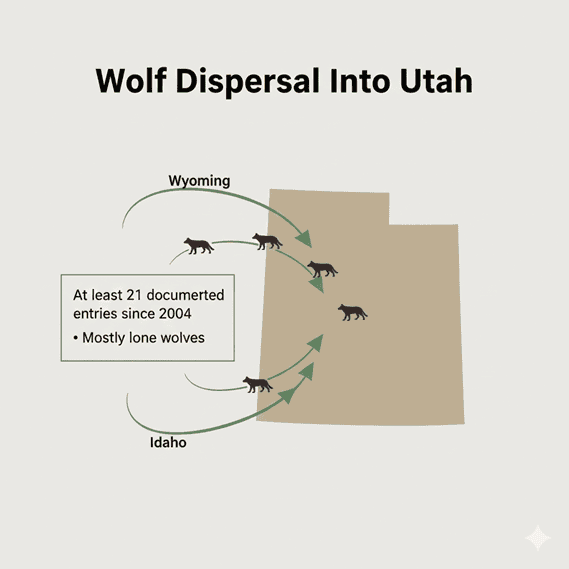
Critics of the recent removal argue that such boundaries create "jurisdictional chaos" where wolves are protected on one side of a line and removed on the other. However, state data underscores the reality of wolf migration; wolves from Wyoming and Idaho have entered Utah at least 21 times since 2004, mostly as lone dispersers. The state’s ability to act in Cache County demonstrates that when empowered, state agencies can effectively enforce boundaries to manage these dispersals. Without such authority, states are often left unable to address predator expansion until after conflicts occur.
Key Lessons From Utah’s Wolf Decision
The removal of three wolves in Northern Utah serves as a definitive example of state management authority in action. It highlights the practical necessity of distinguishing between federal endangered status and state-managed recovery zones. For hunters, ranchers, and rural communities, this incident reinforces the need for continued advocacy to ensure that wildlife management decisions remain in the hands of state agencies, which are best positioned to balance predator conservation with the protection of livestock and ungulate populations.
