

What Happened at the Louisiana CWD Hearing and Why Hunters Should Care
More rules, less say. Hunters are starting to feel the squeeze.
The recent Chronic Wasting Disease (CWD) hearing in Louisiana may have sounded routine, but it carries real consequences for hunters across the state. In simple terms, the state found another case of CWD and responded by expanding restriction zones.
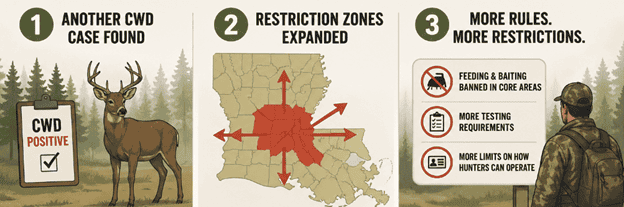
That means more rules, more testing, and more limits on how hunters can operate on their land. For many hunters, the concern is not just the disease itself but how quickly these decisions are being made and how little influence they seem to have in the process.
As of April 2026, the most recent confirmation of Chronic Wasting Disease (CWD) was in Ouachita Parish, as reported by the Louisiana Department of Wildlife and Fisheries (LDWF) on March 12, 2026. At the meeting in Vidalia, the Louisiana Wildlife and Fisheries Commission approved an emergency expansion of CWD control areas. They threw in new parishes under these regulated areas, meaning stricter rules depending on where you are.
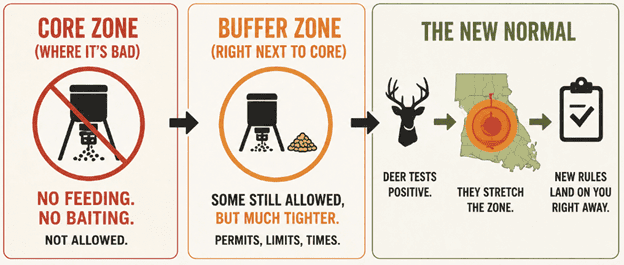
Where the sickness is bad (the core zones), they completely banned feeding and baiting deer. In the zones right next to that (the buffer zones), you can still do a little something, but it's much tighter. This is the new normal: a deer tests positive, they stretch the zone, and the new rules land on you right away.
Hunter Nation’s Position
Hunter Nation knows CWD isn’t something to shrug off. Folks down here take care of the land and the herd because it feeds families and carries on a way of life that’s been here long before any policy showed up. But what’s got people fired up is how these rules are being handed down. A blanket approach might sound good on paper, but it doesn't always fit the woods, the swamps, and the backroads of Louisiana.
Hunters aren’t arguing against testing or keeping an eye on things. That’s part of the responsibility. What they’re saying is you can’t manage deer in Louisiana the same way you would somewhere else and expect it to work. Feeding, watching, managing land, that’s all part of how folks keep tabs on their herd. Take that away without understanding how it’s used, and you’re not fixing the problem, you’re just making it harder to manage.
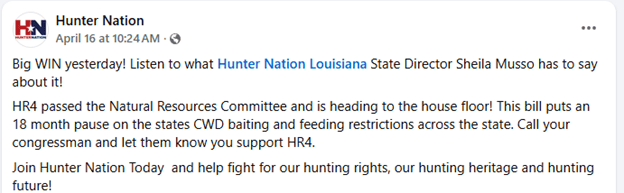
Hunter Nation framed the committee vote as a turning point, posting “Big WIN yesterday!” alongside an update confirming that HR4 had passed the Natural Resources Committee and was advancing to the House floor.
That’s why something like HCR 4 matters. It’s about slowing things down and getting it right instead of pushing rules that don’t line up with what’s really happening out there. It gives hunters a seat at the table instead of talking over them. Around here, that matters. People want to be part of the solution, not pushed to the side like they don’t know their own land.
What’s coming out of places like Vidalia isn’t just frustration, it’s people speaking up for a system that makes sense. Down in Louisiana, hunting isn't just a season. It’s tradition, it’s stewardship, and it’s how folks look after what they’ve got. Hunter Nation is standing on that, making sure the people who live it every day have a say in how it’s protected.
What Hunters Are Saying
Reaction from Louisiana hunters has been immediate and highly visible, with much of the response playing out across public Facebook posts from advocacy groups, local media, and individual hunters.
The organization’s messaging emphasized urgency, with voices like Ted Nugent reinforcing the call for hunters to contact legislators and keep the pressure on. That framing reflects a broader sentiment within the community that engagement is no longer symbolic, it is beginning to produce measurable results.
Local media coverage reinforced the policy shift. KPLC 7 News reported that the resolution would “ease restrictions by allowing hunters to feed deer in monitored zones from Sept. 1 through March 31.” For many hunters, that detail is central. It aligns more closely with how deer are actually managed in the field and supports the argument that regulated feeding can coexist with monitoring efforts rather than undermine them.
At the grassroots level, individual hunters are grounding the debate in data. Barry McCain shared widely circulated figures, writing “LA CWD Cases to Date = 55… LA Deer population = 600k…” to question whether current restrictions match the scale of the issue.
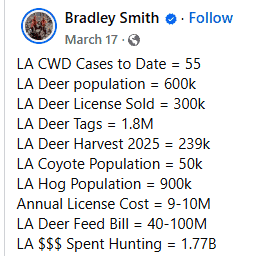
That comparison has become a recurring reference point, reinforcing skepticism about whether blanket policies are proportionate to the actual risk. State agencies, including the Louisiana Department of Wildlife and Fisheries, continue to stress that CWD is a real concern and something that needs to be taken seriously.
That message isn’t being ignored. But out in the field, a lot of hunters feel like decisions are getting made from offices far removed from the woods they hunt. The growing frustration is not about the goal, it is about the process. Hunters see policies coming down that do not always match what they are seeing day to day, and many believe their experience is not being fully factored into how these rules are shaped.
Where to See It Yourself
For those who want to see the details firsthand, the Louisiana Wildlife and Fisheries Commission provides access to meeting records and video archives. Public discussion is also taking place across social media platforms where hunters and organizations are sharing their perspectives. Hunter Nation continues to track these developments and provide updates so hunters stay informed and engaged.
The takeaway is simple. The system being built around CWD is growing quickly. Each new case leads to more restrictions, and once those restrictions are in place, they are difficult to roll back. If hunters are not involved early, their ability to influence these decisions later becomes limited. Hunter Nation’s role is to make sure hunters remain at the center of conservation efforts and that their voices are not pushed aside as policies continue to expand.