

Rebuilding the Base: Turning Shooters Into Hunters to Save the Tradition
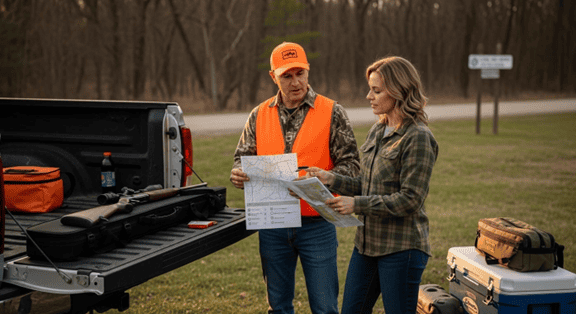
Traditional recruitment methods are failing to stop the slide, but a new focus on adult-onset hunting and range crossover can help rebuild participation.
Stabilizing the Slide
There is good news: the freefall may be slowing. The Council to Advance Hunting and the Shooting Sports (CAHSS) reports that after years of volatility, national hunting license sales were nearly flat in 2023, with a decrease of only 0.3%. Stability is not a victory, but it is a platform to build upon.
To start growing again, agencies and organizations are adopting a strategy called R3: Recruitment, Retention, and Reactivation.
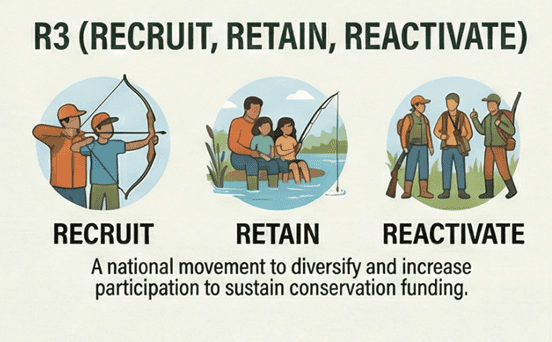
Why “Youth-Only” Isn’t Enough
For decades, recruitment focused almost exclusively on youth events. While well-intentioned, the data shows these programs often reinforce existing hunting households rather than creating new ones.
“Even if the most optimistic scenario occurs, the gains would fall well short of the projected declines in the male hunter population.”
— Adam Moore, Research Scientist, Wisconsin DNR Office of Applied Sciences
The Congressional Sportsmen’s Foundation notes that evaluations of Wisconsin’s “Learn to Hunt” program found that 80% of participants already had fathers who hunted. These programs are excellent for retention—but they are poor at recruitment (creating net-new participation).
The “Crossover” Opportunity
The most logical place to find new hunters is the local shooting range. The National Shooting Sports Foundation (NSSF) estimates there are approximately 100 million firearm owners in the U.S., yet only about 50 million people actively participate in hunting or target shooting annually.
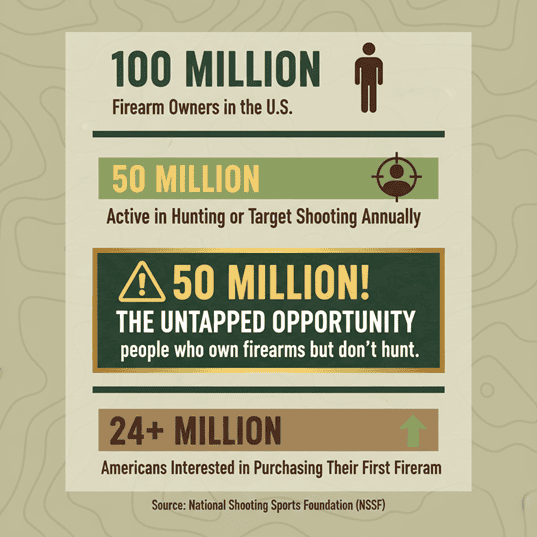
This leaves a gap of tens of millions of people who own the gear, know the safety rules, and are comfortable with firearms, but have never entered the woods. Furthermore, NSSF research indicates there are 24 million+ Americans interested in purchasing their first firearm. This is a target audience for structured on-ramps.
Modernizing the Approach
Forward-thinking states are pivoting. The Wisconsin DNR R3 grant framework explicitly targets “adults, females and families” for pilot programs. Changes to the Pittman-Robertson Act in 2019 modernized how funds can be used, allowing federal dollars to support recruitment and related outreach tools.
We don’t need to convince people to like guns; we need to teach gun owners how to source their own food. Adult-onset hunters have the money, the transportation, and the motivation to adopt the lifestyle immediately.
This shift acknowledges that we cannot rely on tradition alone to save hunting; we need a deliberate, repeatable pipeline that turns recreational shooters into conservationists. The fastest way to rebuild is to lower the real barriers: access, skills, and confidence. This requires existing hunters to step up as mentors, not just guides—teaching scouting, field dressing, and processing to the person in the next lane at the range. When specific knowledge transfer meets state-backed on-ramps, “interested” becomes “activated,” and activated becomes “retained.” That’s how the tradition survives—not by hoping for a comeback, but by building one on purpose.