

The Empty Stand: New Projections Show a Crisis in Hunter Replacement
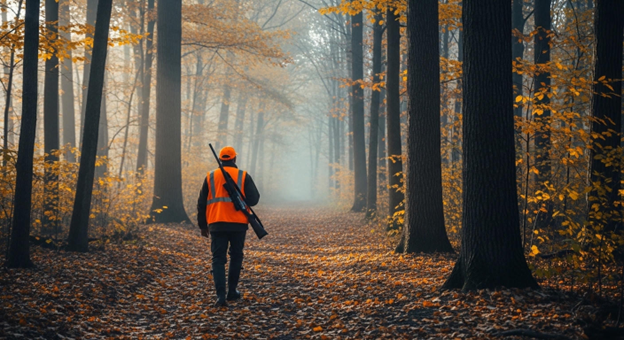
Projections from Wisconsin suggest a demographic cliff is approaching, but the decline started long before the Baby Boomers began hanging up their gear.
The Decline Is Already Here
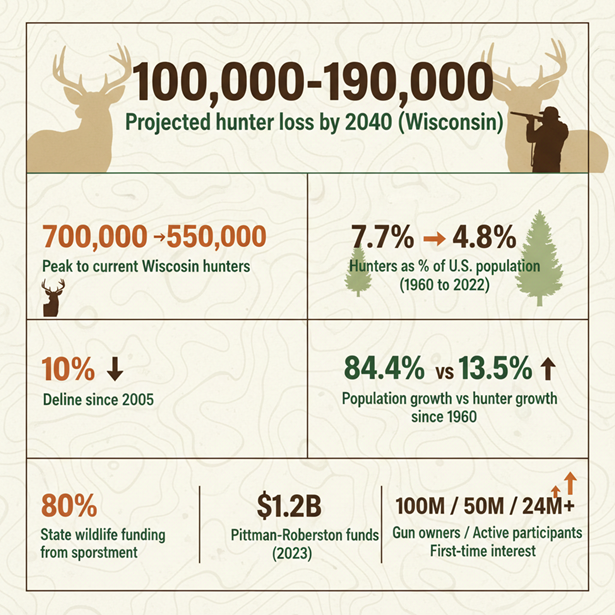
New projections are flashing a warning sign for the future of our hunting heritage. In Wisconsin, research scientists from the Department of Natural Resources (DNR) recently delivered a sobering forecast to the Natural Resources Board: the state could lose 100,000–190,000 male deer hunters by 2040.
This is not a future theoretical problem; it is the acceleration of a trend that has been eroding participation for decades. According to figures cited in reporting on Wisconsin DNR projections, gun deer hunting peaked in the 1990s at approximately 700,000 hunters. Since then, that number has dropped by roughly 150,000. The slide is consistent across seasons, with the state losing about 10% of deer hunters across all license types since 2005.
It’s Not Just About Age
For years, the comfortable explanation for declining numbers was that the “Baby Boomer” generation was simply aging out. However, the data suggests the problem is structural: we are failing to replace hunters at the rate they leave.
“The decline started well before baby boomers would have been dropping out due to age.”
— Adam Moore, Research Scientist, Wisconsin DNR Office of Applied Sciences
If we blame age alone, we miss the reality that recruitment has not kept pace with modern culture. The drop isn’t just a biological inevitability; it is a failure to bring new blood into the stand.
The National Reality Check
Wisconsin’s data serves as a case study for a national crisis. While the United States population has exploded, the hunting population has stagnated.
Wildlife for All reports that since 1960, the total U.S. population has grown by +84.4%. In that same period, the number of hunters grew by only +13.5%. The result is a massive dilution of our presence. In 1960, hunters represented 7.7% of the population. By 2022, that share plummeted to 4.8%. We are becoming a smaller voice in a more crowded room.
Why It Matters
When hunter numbers drop, the “boots on the ground” management of wildlife disappears. We are the primary tool for managing herd health. Without us, populations spiral.
“The issues with deer overabundance, forest and crop damage, deer/vehicle collisions, CWD spread, they’re just simply going to worsen.”
— Dan Storm, Research Scientist, Wisconsin DNR Office of Applied Sciences
First, acknowledge the trend and share this data with your camp. Understanding that this is a structural replacement issue, not just “old age,” is the first step to fixing it.
Second, look beyond the family. If we only recruit our own children, we only maintain the status quo. We must look outside our immediate circle.
The trend is clear: if we don’t replace hunters as fast as we lose them, the decline keeps compounding. Wisconsin’s numbers are a warning for the Midwest, but they’re also a call to action. The fix starts local: grow the circle, bring someone new into the stand, and treat recruitment as a habit, not a one-time event.